An AI fact checker that reads the original papers
Attach a draft and ask for a claim table. Bearly checks research claims against the papers, the rest against the web, and shows what each source says.
Attach a draft to a Bearly chat and ask for a fact check. Bearly pulls out each factual claim, checks research claims against the papers themselves with Scholar and everything else against the web, and returns a table: the claim, a verdict, what the source actually says, and a link to it. You decide what to change.
A draft with two planted errors
We wrote a five-paragraph blog post arguing for the four-day week, with a dozen checkable claims. Most were accurate. Two were wrong on purpose: it said more than half of American workers are fully remote, and that a Harvard study found open offices increased face-to-face interaction by 70%.
We attached the draft and sent this to GPT 6 Sol:
Fact-check this draft before I publish it. For every factual claim, give me a table with the claim, a verdict (supported, wrong, or unclear), what the source actually says, and the source. Check the research claims against the papers themselves, not news coverage.
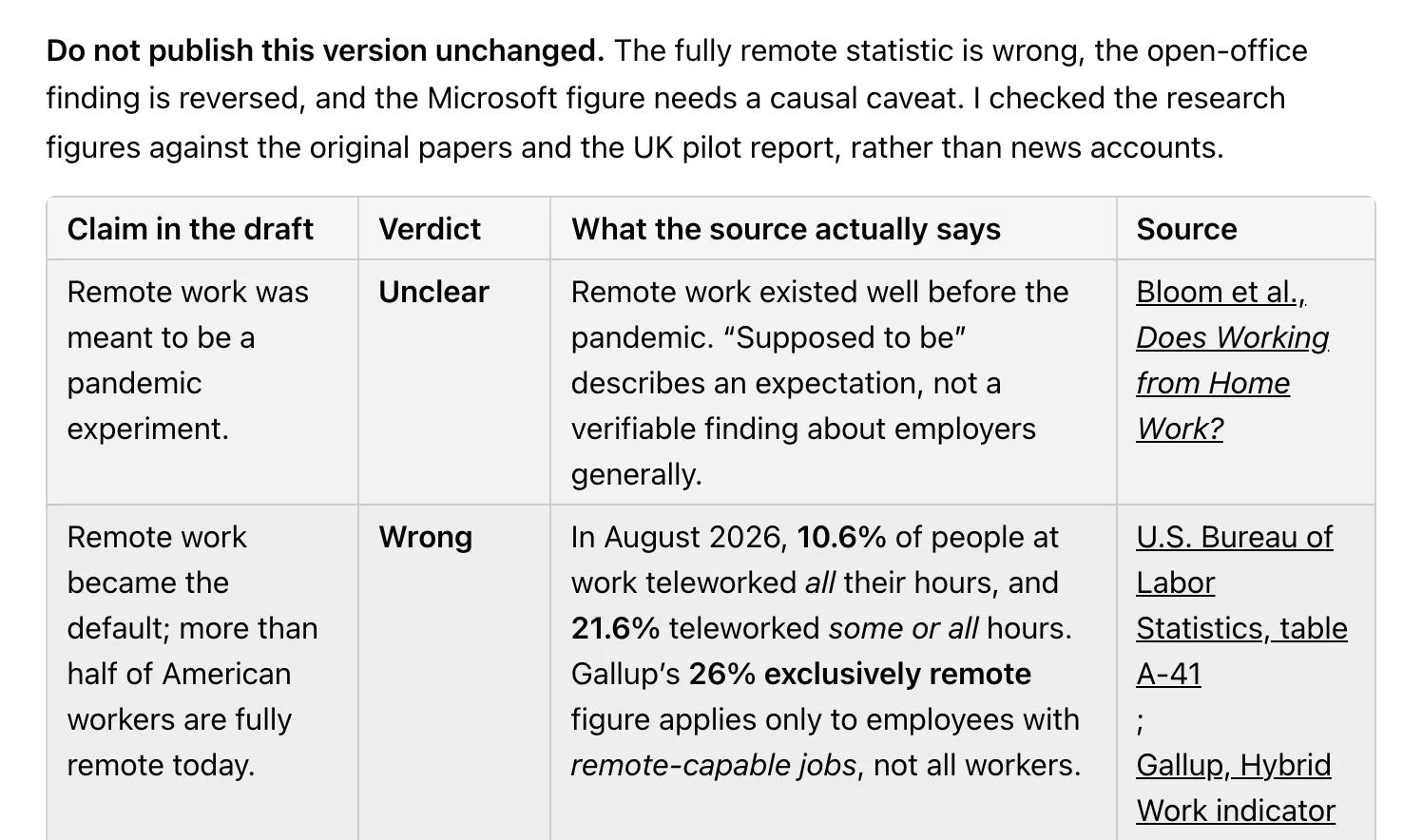
Bearly ran four paper searches, read passages from one of the papers, and searched the web for the rest. About five minutes later, the reply opened with a verdict on the whole draft, followed by a 12-row table.
What it caught
Both planted errors, each with the correction beside it:
- Remote work. Wrong. In August 2026, 10.6% of people at work teleworked all of their hours and 21.6% teleworked some or all of them, according to the Bureau of Labor Statistics.
- Open offices. Reversed. The study followed two companies that moved to open-plan headquarters and found face-to-face interaction fell by about 70%, while email and messaging rose.
It also caught one we hadn't planted. The draft said Microsoft Japan's productivity rose 40% during its 2019 four-day week. The figure is real: sales per employee in August 2019 were 39.9% higher than a year earlier. But Microsoft later amended its announcement to say the trial wasn't the only cause. Bearly marked the claim unclear and suggested a causal caveat. We'd had that sentence down as accurate when we wrote the test.
The claims it supported came back more precise than we wrote them. The 2015 study of a Chinese travel company measured a 13% performance gain among call-center volunteers who worked from home four days a week. In the UK's 2022 pilot, 56 of 61 companies were continuing the four-day week when the trial ended, and 18 had made it permanent.
We checked each of those corrections ourselves before writing this.
Why ask for the source's own words
The "what the source actually says" column is what makes the table checkable. A verdict on its own asks you to trust the model. The finding in the source's words, next to a link, takes a minute to confirm.
Asking for the papers rather than the coverage matters too, because a news story can round a number or drop a caveat that the paper keeps. Scholar marks the papers it read under the reply and quotes the passages it relied on, so you can see what each verdict rests on.
Videos, too
A talk makes claims just like a draft does. Paste a YouTube link into a chat, and on the video's card, Check claims lists the figures the video states and counts the sites that give the same figure or a different one. Check a YouTube talk before you watch it explains how to read the results.
Limits
- A verdict is the model's reading of the source. Open the link before you rewrite a sentence, especially one marked unclear.
- Scholar reads a paper's full text when it's available. Otherwise it reads the abstract, which is common for biomedical papers.
- Claims about current figures depend on what web search finds that day.
- It checks what the draft says. It won't tell you what the draft leaves out.
Scholar works on every plan, and it's on by default. The Scholar guide covers when Bearly uses papers and how to read its citations.